
Listening Therapies
Healing Doesn't Always Come From Talking
Healing Doesn't Always Come From Talking
We carry our experiences not only in our stories and memories, but in our bodies. Trauma and chronic stress leave lasting imprints on the nervous system, so healing means tending to the body too. Listening therapies offer a gentle, bottom-up way to support regulation, restoration, and connection.
We carry our experiences not only in our stories and memories, but in our bodies. Trauma and chronic stress leave lasting imprints on the nervous system, so healing means tending to the body too. Listening therapies offer a gentle, bottom-up way to support regulation, restoration, and connection.
Percentages of participants who reported improved symptoms in:
Percentages of participants who reported improved symptoms in:
ANXIETY
85%
63% moved to non-clinical levels after one round.
TRAUMA
85%
57% moved to non-clinical levels after one round.
DEPRESSION
85%
53% moved to non-clinical levels after one round.
Anxiety
85%
63% moved to non-clinical
levels after one round.
Trauma
87%
57% moved to non-clinical
levels after one round.
Depression
81%
53% moved to non-clinical
levels after one round.
What Are
Listening Therapies?
Your nervous system is constantly taking in information from the world around you and from inside your body. It is continually assessing, often outside of conscious awareness, whether you are safe, under threat, connected, overwhelmed, or in need of protection.
When the nervous system has been shaped by chronic stress, trauma, anxiety, illness, or prolonged periods of overwhelm, it can become difficult to shift out of protective states. You may understand intellectually that you are safe while your body continues to respond as though danger is present.
Your nervous system is constantly taking in information from the world around you and from inside your body. It is continually assessing, often outside of conscious awareness, whether you are safe, under threat, connected, overwhelmed, or in need of protection.
When the nervous system has been shaped by chronic stress, trauma, anxiety, illness, or prolonged periods of overwhelm, it can become difficult to shift out of protective states. You may understand intellectually that you are safe while your body continues to respond as though danger is present.
You may notice:
Feeling constantly “on edge”
Feeling constantly “on edge”
Difficulty relaxing even when you are safe
Difficulty relaxing even when you are safe
Feeling emotionally overwhelmed or easily activated
Feeling emotionally overwhelmed or easily activated
Trouble sleeping
Trouble sleeping
Feeling disconnected, numb, or shut down
Feeling disconnected, numb, or shut down
Sensitivity to sound or other sensory input
Sensitivity to sound or other sensory input
Difficulty concentrating
Difficulty concentrating
Feeling exhausted but unable to truly rest
Feeling exhausted but unable to truly rest
Difficulty feeling connected to yourself or other people
Difficulty feeling connected to yourself or other people
Knowing intellectually that you are safe but not actually feeling safe
Knowing intellectually that you are safe but not actually feeling safe

Listening therapies take a bottom-up approach, working with the body and nervous system rather than asking you to think your way into feeling better. Through specially designed auditory input, they give your nervous system an opportunity to experience something different.
This can be especially helpful when you understand your patterns and reactions intellectually, but your body still responds as though you're in danger.
Sometimes you know you're safe, but you don't actually feel safe.
Sometimes you know you're safe, but you don't actually feel safe.
Listening therapies can help support the nervous system in becoming more regulated, flexible, and able to experience greater safety and connection.
The Listening Therapies I Offer
The Listening
Therapies I Offer
In my practice, I offer two specialized, evidence-based listening therapies from Unyte Health:
Safe and Sound Protocol™
Supporting Safety, Emotional Regulation, and Connection
Rest and Restore Protocol™
Supporting Rest, Restoration, and Physiological Balance
Each works with the nervous system differently, offering another pathway toward healing for people who feel anxious, overwhelmed, depressed, disconnected, chronically stressed, exhausted, or simply unable to fully access the benefits of traditional talk therapy.
Together, these approaches are designed to help create the physiological conditions that make regulation, connection, and therapeutic change more accessible.
Both protocols involve approximately five hours of specially designed music, typically listened to over the course of one to three months, allowing the experience to be paced according to your individual needs and response.


Safe and Sound (SSP)
Rest and Restore (RRP)
Safe and Sound Protocol™ (SSP)
Supporting Safety, Emotional Regulation,
and Connection
The Safe and Sound Protocol is a therapist-guided listening intervention developed by Dr. Stephen Porges.
It uses specially filtered music designed to emphasize frequencies associated with the human voice. The intention is to support the nervous system's ability to detect cues of safety and become more flexible in moving between states of activation and regulation.
In simple terms
SSP is about helping your nervous system become more comfortable with safety and connection.
SSP is not a replacement for psychotherapy. In my practice, it can be used as a standalone listening therapy or integrated with psychotherapy approaches such as EMDR and other trauma-informed therapies to help create a stronger foundation for therapeutic work.

Want to learn more about the SSP? Visit the SSP website.
SSP may be particularly helpful for people experiencing:
Trauma and PTSD symptoms, especially effective with those who have experienced betrayal trauma
Anxiety and chronic stress
Emotional dysregulation and reactivity
Sensory overwhelm
Difficulty feeling safe or connected
Social or relational difficulties
Hypervigilance
Difficulty settling after stressful experiences
Sleep and digestion problems

Research
What does the research show?
Research on the Safe and Sound Protocol shows meaningful improvements in several key areas:
85%
Participants reported improvement in anxiety symptoms
63% moved from clinical to non-clinical levels after one round.
87%
Participants reported improvement in trauma symptoms
57% moved from clinical to non-clinical levels after one round.
81%
Participants reported improvement in depression symptoms
53% moved from clinical to non-clinical levels after one round.
Want to learn more about the research behind the SSP? Read the Unyte Health White Paper
Safe and Sound (SSP)
Rest and Restore (RRP)
Safe and Sound Protocol™ (SSP)
Supporting Safety, Emotional Regulation, and Connection
The Safe and Sound Protocol is a therapist-guided listening intervention developed by Dr. Stephen Porges.
It uses specially filtered music designed to emphasize frequencies associated with the human voice. The intention is to support the nervous system's ability to detect cues of safety and become more flexible in moving between states of activation and regulation.
In simple terms
SSP is about helping your nervous system become more comfortable
with safety and connection.
SSP is not a replacement for psychotherapy. In my practice, it can be used as a standalone listening therapy or integrated with psychotherapy approaches such as EMDR and other trauma-informed therapies to help create a stronger foundation for therapeutic work.
Want to learn more about the SSP? Visit the SSP website.
SSP may be particularly helpful for people experiencing:
Trauma and PTSD symptoms, especially effective with those who have experienced betrayal trauma
Anxiety and chronic stress
Emotional dysregulation and reactivity
Sensory overwhelm
Difficulty feeling safe or connected
Social or relational difficulties
Hypervigilance
Difficulty settling after stressful experiences
Sleep and digestion problems
Research
What does the research show?
Research on the Safe and Sound Protocol shows meaningful improvements in several key areas:
85%
Participants reported improvement in anxiety symptoms
63% moved from clinical to non-clinical levels after one round.
87%
Participants reported improvement in trauma symptoms
57% moved from clinical to non-clinical levels after one round.
81%
Participants reported improvement in depression symptoms
53% moved from clinical to non-clinical levels after one round.
Want to learn more about the research behind the SSP?
Read the Unyte Health White Paper
SSP
RRP
Safe and Sound Protocol™ (SSP)
Supporting Safety, Emotional Regulation, and Connection
The Safe and Sound Protocol is a therapist-guided listening intervention developed by Dr. Stephen Porges.
It uses specially filtered music designed to emphasize frequencies associated with the human voice. The intention is to support the nervous system's ability to detect cues of safety and become more flexible in moving between states of activation and regulation.
In simple terms
SSP is about helping your nervous system become more comfortable with safety and connection.
SSP is not a replacement for psychotherapy. In my practice, it can be used as a standalone listening therapy or integrated with psychotherapy approaches such as EMDR and other trauma-informed therapies to help create a stronger foundation for therapeutic work.
Want to learn more about the SSP? Visit the SSP website.
SSP may be particularly helpful for people experiencing:
Trauma and PTSD symptoms, especially effective with those who have experienced betrayal trauma
Anxiety and chronic stress
Emotional dysregulation and reactivity
Sensory overwhelm
Difficulty feeling safe or connected
Social or relational difficulties
Hypervigilance
Difficulty settling after stressful experiences
Sleep and digestion problems
Research
What does the research show?
Research on the Safe and Sound Protocol shows meaningful improvements in several key areas:
Want to learn more about the research behind the SSP? Read the Unyte Health White Paper
85%
Participants reported improvement in anxiety symptoms
63% moved to non-clinical levels after one round.
87%
Participants reported improvement in trauma symptoms
57% moved to non-clinical levels after one round.
81%
Participants reported improvement in depression symptoms
53% moved to non-clinical levels after one round.
Safe and Sound (SSP)
Rest and Restore (RRP)
Safe and Sound Protocol™ (SSP)
Supporting Safety, Emotional Regulation,
and Connection
The Safe and Sound Protocol is a therapist-guided listening intervention developed by Dr. Stephen Porges.
It uses specially filtered music designed to emphasize frequencies associated with the human voice. The intention is to support the nervous system's ability to detect cues of safety and become more flexible in moving between states of activation and regulation.
In simple terms
SSP is about helping your nervous system become more comfortable with safety and connection.
SSP is not a replacement for psychotherapy. In my practice, it can be used as a standalone listening therapy or integrated with psychotherapy approaches such as EMDR and other trauma-informed therapies to help create a stronger foundation for therapeutic work.
Want to learn more about the SSP? Visit the SSP website.
SSP may be particularly helpful for people experiencing:
Trauma and PTSD symptoms, especially effective with those who have experienced betrayal trauma
Anxiety and chronic stress
Emotional dysregulation and reactivity
Sensory overwhelm
Difficulty feeling safe or connected
Social or relational difficulties
Hypervigilance
Difficulty settling after stressful experiences
Sleep and digestion problems
Research
What does the research show?
Research on the Safe and Sound Protocol shows meaningful improvements in several key areas:
85%
Participants reported improvement in anxiety symptoms
63% moved from clinical to non-clinical levels after one round.
87%
Participants reported improvement in trauma symptoms
57% moved from clinical to non-clinical levels after one round.
81%
Participants reported improvement in depression symptoms
53% moved from clinical to non-clinical levels after one round.
Want to learn more about the research behind the SSP? Read the Unyte Health White Paper
SSP or RRP?
Which one is right for me?
SSP or RRP?
Which one is right for me?
There isn't one answer.
I often tell my clients that if everyone in the world could experience a round of these listening therapies, we'd be living in a very different world.
I often tell my clients that if everyone in the world could experience a round of these listening therapies, we'd be living in a very different world.
That being said, there is often a clear starting point.
I look at your history, current symptoms, how your nervous system tends to respond to stress, and what you're hoping to change to determine which protocol may be most supportive as a starting point.
That being said, there is often a clear starting point. I look at your history, current symptoms, how your nervous system tends to respond to stress, and what you're hoping to change to determine which protocol may be most supportive as a starting point.
SSP
Tends to focus on safety, connection, and engagement, supporting co-regulation and our capacity to connect with others.
RRP
Tends to focus on rest, restoration, and recovery, supporting interoception and our capacity to connect with ourselves.
And sometimes, the answer is both.
And sometimes, the answer is both.
They can be used separately, sequentially, or together depending on what your nervous system needs.
They can be used separately, sequentially, or together depending on what your nervous system needs.
They can be used separately, sequentially, or together depending on what your nervous system needs.
Focus
Primary emphasis
Supports
Often helpful when you feel
SSP
Safety & Connection
Regulation, engagement & connection
Connection with others & co-regulation
Disconnected, guarded, hypervigilant, or unable to fully engage with others
RRP
Rest & Restoration
Restoration, recovery & physiological balance
Connection with yourself & interoception
Depleted, exhausted, disconnected from yourself, or unable to truly rest
SSP
SSP
Focus
Focus
Safety & Connection
Safety & Connection
Primary emphasis
Primary emphasis
Regulation, engagement & connection
Regulation, engagement & connection
Supports
Supports
Connection with others & co-regulation
Connection with others & co-regulation
Often helpful when you feel
Often helpful when you feel
Disconnected, guarded, hypervigilant, or unable to fully engage with others
Disconnected, guarded, hypervigilant, or unable to fully engage with others
RRP
RRP
Focus
Focus
Rest & Restoration
Rest & Restoration
Primary emphasis
Primary emphasis
Restoration, recovery & physiological balance
Restoration, recovery & physiological balance
Supports
Supports
Connection with yourself & interoception
Connection with yourself & interoception
Often helpful when you feel
Often helpful when you feel
Depleted, exhausted, disconnected from yourself, or unable to truly rest
Depleted, exhausted, disconnected from yourself, or unable to truly rest
What Can I Expect?
What Can I Expect?
Listening therapy is intentionally different
from traditional therapy.
Listening therapy is intentionally different
from traditional therapy.
You don't have to talk about your trauma while you listen.
You don't have to talk about your trauma while you listen.
You don't have to analyze anything or try to make anything happen.
You don't have to analyze anything or try to make anything happen.
You simply listen and allow your nervous system to respond
You simply listen and allow your nervous system to respond

01
Before You Begin
Before You Begin
We'll talk about your goals, symptoms, history, and what you're hoping to get from the experience.
We'll talk about your goals, symptoms, history, and what you're hoping to get from the experience.
I'll explain the process, answer any questions you have, and help determine which protocol is the best place to begin.
I'll explain the process, answer any questions you have, and help determine which protocol is the best place to begin.
02
During Listening
During Listening
We'll begin by listening together for 5–10 minutes, either in the office or virtually.
We'll begin by listening together for 5–10 minutes, either in the office or virtually.
I'll show you how to access and use the music, and then you'll complete the remainder of your protocol on your own at home.
I'll show you how to access and use the music, and then you'll complete the remainder of your protocol on your own at home.
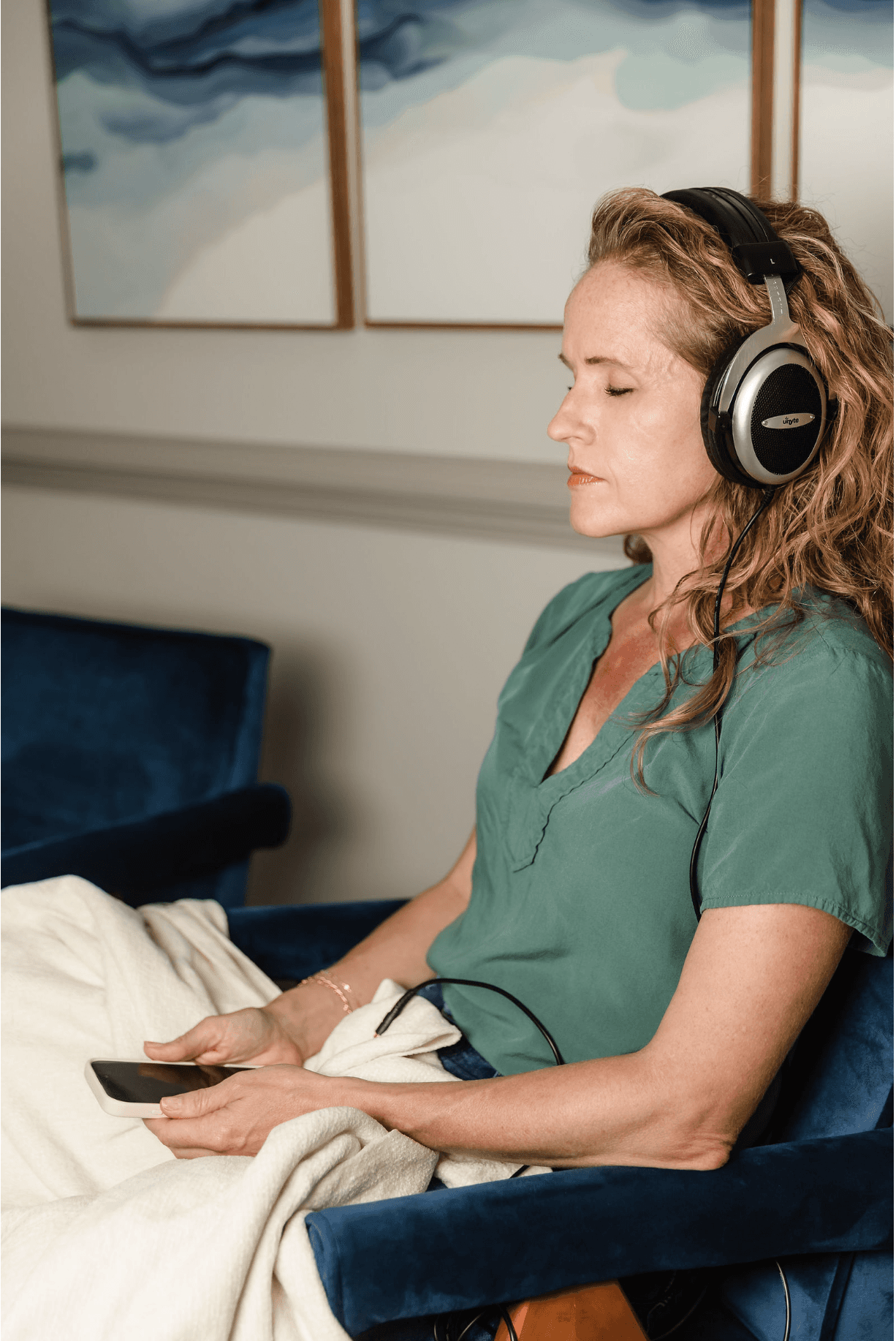
You'll listen to specially designed music through headphones while sitting or resting comfortably.
You'll listen to specially designed music through headphones while sitting or resting comfortably.
There's nothing you need to analyze, figure out, or accomplish while you listen. You simply listen and allow your nervous system to respond.
There's nothing you need to analyze, figure out, or accomplish while you listen. You simply listen and allow your nervous system to respond.
I'll guide you throughout the process and monitor how your nervous system is responding, making adjustments as needed to help you have a comfortable and supportive experience.
I'll guide you throughout the process and monitor how your nervous system is responding, making adjustments as needed to help you have a comfortable and supportive experience.
03
After Listening
After Listening
We'll pay attention to what you notice, not just emotionally, but physically, internally, and relationally.
We'll pay attention to what you notice, not just emotionally, but physically, internally, and relationally.
As your nervous system becomes more regulated, the changes you notice can be far-reaching and may show up in many different areas of your life.
As your nervous system becomes more regulated, the changes you notice can be far-reaching and may show up in many different areas of your life.
Some people notice changes quickly. For others, changes are subtle and become more apparent over time.
Some people notice changes quickly. For others, changes are subtle and become more apparent over time.
More is not
necessarily better.
More is not
necessarily better.
Listening is titrated to your individual response. Most people do best with shorter listening sessions spaced throughout the week, rather than completing longer sessions all at once.
Your response is more important than the amount of time you listen. We'll adjust the pace and duration based on how your nervous system responds.
Listening is titrated to your individual response. Most people do best with shorter listening sessions spaced throughout the week, rather than completing longer sessions all at once.
Your response is more important than the amount of time you listen. We'll adjust the pace and duration based on how your nervous system responds.
Why Add Listening Therapy
to Psychotherapy?
Why Add Listening Therapy to Psychotherapy?
Traditional psychotherapy
Often works from the top down, using awareness, insight, language, and cognitive and emotional processing.
Listening therapies
Offer a bottom-up complement, working with physiological regulation and the nervous system.
This can be particularly valuable when you understand your patterns intellectually, but your body continues to respond as though danger is present. Or, conversely, you may be so dysregulated that insight and therapeutic work are
difficult to access.
By supporting nervous system regulation, listening therapies may help create the conditions for greater presence, self-awareness, and engagement in the therapeutic process.
This can be particularly valuable when you understand your patterns intellectually, but your body continues to respond as though danger is present. Or, conversely, you may be so dysregulated that insight and therapeutic work are
difficult to access.
By supporting nervous system regulation, listening therapies may help create the conditions for greater presence, self-awareness, and engagement in the therapeutic process.
Listening therapy doesn't replace the therapeutic work. It can help create a nervous system that is more available
to do the work.
This is one reason I may integrate SSP or RRP with EMDR and other trauma-informed approaches.
This is one reason I may integrate SSP or RRP with EMDR and other trauma-informed approaches.



Your investment
Listening Therapy Investment
The pace of listening is individualized. Some people move through the protocol more quickly, while others benefit from a slower, more gradual approach. The goal is to listen in a way that feels supportive and manageable for your nervous system.
$300
Three-Month Listening Program
Both Safe and Sound Protocol™ (SSP) and Rest and Restore Protocol™ (RRP) are offered as a three-month listening program.
Your investment includes three months of access to your selected listening protocol, along with guidance and support as you move through the program.
$150
Continuing or Repeating a Protocol
If you have previously completed a three-month listening program and would like to access the protocol again, subsequent three-month programs are $150.
Listening is not necessarily a one-and-done experience. For some people, repeated rounds of listening can support greater nervous-system regulation and create opportunities for deeper healing over time.
This can be helpful for clients who want to revisit listening therapy during a particularly stressful season, continue supporting nervous-system regulation, or incorporate listening as an ongoing part of their therapeutic care.
Your investment
Listening Therapy Investment
The pace of listening is individualized. Some people move through the protocol more quickly, while others benefit from a slower, more gradual approach. The goal is to listen in a way that feels supportive and manageable for your nervous system.
$300
Three-Month Listening Program
Both Safe and Sound Protocol™ (SSP) and Rest and Restore Protocol™ (RRP) are offered as a three-month listening program.
Your investment includes three months of access to your selected listening protocol, along with guidance and support as you move through the program.
$150
Continuing or Repeating a Protocol
If you have previously completed a three-month listening program and would like to access the protocol again, subsequent three-month programs are $150.
Listening is not necessarily a one-and-done experience. For some people, repeated rounds of listening can support greater nervous-system regulation and create opportunities for deeper healing over time.
This can be helpful for clients who want to revisit listening therapy during a particularly stressful season, continue supporting nervous-system regulation, or incorporate listening as an ongoing part of their therapeutic care.
FAQs
Frequently Asked
Questions
Frequently Asked Questions
Do I have to be in therapy to use listening therapy?
Do I have to talk about my trauma while listening?
How long does it take?
Can listening therapy make me feel worse?
What if I don't like the music?
Can I listen at home?
Will I know immediately if it's working?
Interested in Learning More?
Interested in
Learning More?
Schedule a brief video consultation to talk about your goals and whether SSP, RRP, psychotherapy, or a combination of approaches may be a good fit for you.
Schedule a brief video consultation to talk about your goals and whether SSP, RRP, psychotherapy, or a combination of approaches may be a good fit for you.
Shame dies when stories are
told in safe places
—Ann Voskamp
Shame dies when stories are
told in safe places
—Ann Voskamp
Shame dies when stories are
told in safe places
—Ann Voskamp